The Dopamine Trap: Why Social Media Feels Impossible to Quit
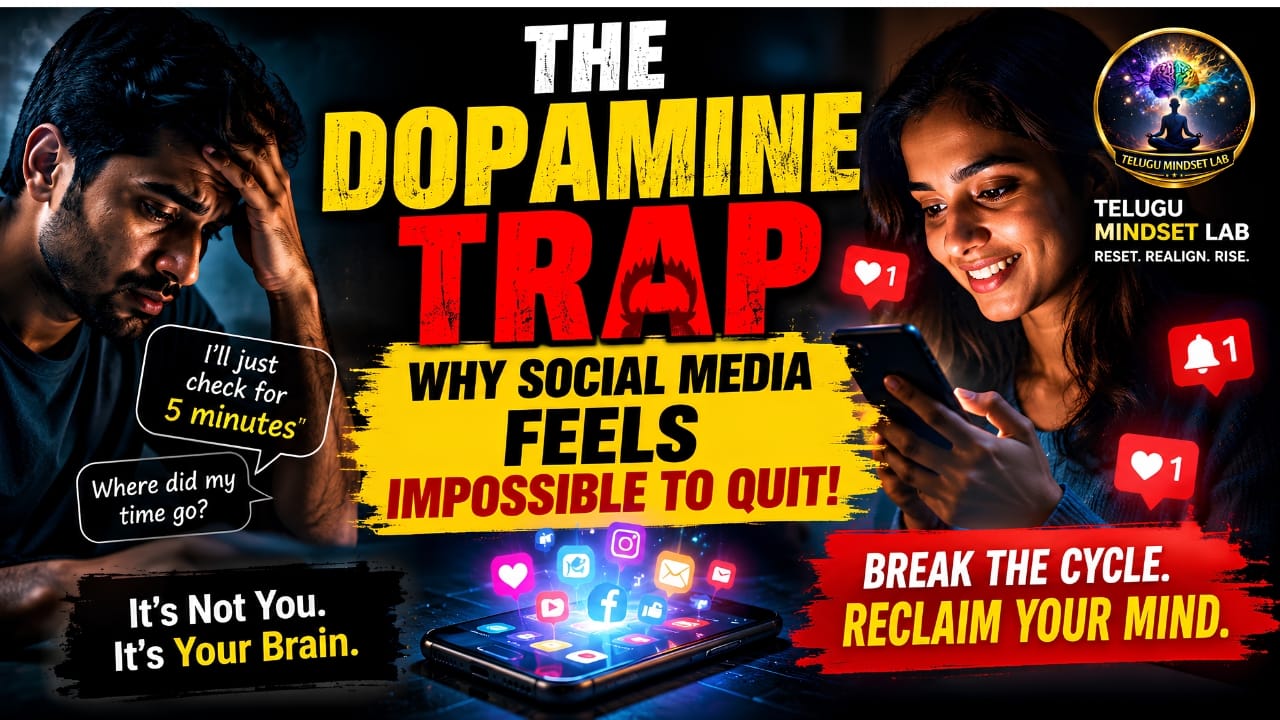
The Dopamine Trap: Why Social Media Feels Impossible to Quit
It's Not a Willpower Problem. It's a Brain Problem.
Have you ever picked up your phone to check one message and somehow ended up scrolling for thirty minutes?
You promised yourself it would be quick.
Just one notification.
Just one video.
Just one look.
And then, somehow, time disappeared.
Suddenly, you look up and wonder:
"Where did the last half hour go?"
If this sounds familiar, you're not alone.
In fact, millions of intelligent, hardworking, and highly motivated people struggle with exactly the same problem every single day.
Yet most of them come to the wrong conclusion.
They tell themselves:
"I have no discipline."
"I need more self-control."
"I am addicted to my phone."
However, after years of studying psychology, neuroscience, emotional regulation, and human behavior, I've come to a very different conclusion.
Most people are not weak.
Most people are not lazy.
Most people are simply trapped inside a system that was expertly designed to capture and hold their attention.
And the key player behind this invisible trap is dopamine.
The Great Misunderstanding About Dopamine
Most people call dopamine the "feel-good chemical."
That sounds simple.
Unfortunately, it is also incomplete.
Dopamine does not exist primarily to make you happy.
Instead, dopamine exists to make you seek.
To search.
To anticipate.
To explore.
To check.
To refresh.
To look one more time.
This distinction changes everything.
Because when you understand dopamine properly, you stop blaming yourself for your behavior.
And you start understanding why social media feels almost impossible to resist.
Why Your Brain Loves Uncertainty
Imagine walking into a casino.
You pull a slot machine lever.
Sometimes you win.
Sometimes you don't.
Now imagine carrying that slot machine in your pocket twenty-four hours a day.
That is essentially what social media has become.
Every swipe creates uncertainty.
Maybe you'll see a funny video.
Maybe you'll receive a message.
Maybe someone liked your post.
Maybe something exciting happened.
Maybe not.
Your brain doesn't know.
And that's exactly why it keeps checking.
The uncertainty itself becomes rewarding.
The possibility becomes addictive.
And therefore, every refresh triggers another wave of anticipation.
Not satisfaction.
Anticipation.
That's dopamine at work.
Why Smart People Fall Into The Trap
One of the biggest myths about social media addiction is that only careless people struggle with it.
Nothing could be further from the truth.
In fact, many highly intelligent people struggle even more.
Why?
Because intelligent minds are naturally curious.
They want information.
They want answers.
They want updates.
They want insights.
Social media delivers all of these things instantly.
As a result, curiosity becomes hijacked.
Instead of learning intentionally, we begin consuming endlessly.
Instead of seeking knowledge, we start chasing stimulation.
And slowly, without realizing it, our attention becomes fragmented.
The Attention Economy Is Competing For Your Brain
Here's something most people never think about.
Social media companies are not selling content.
They are selling attention.
Your attention.
My attention.
Everyone's attention.
Every extra second you spend scrolling creates value for the platform.
Therefore, thousands of engineers, psychologists, behavioral scientists, and designers constantly work to make apps more engaging.
Not necessarily because they want to harm you.
But because their business model depends on keeping you there.
As a result:
Notifications become brighter.
Feeds become endless.
Videos become shorter.
Recommendations become smarter.
Algorithms become more personalized.
And your attention becomes harder to reclaim.
The Hidden Cost Nobody Talks About
Most discussions about social media focus on wasted time.
However, I believe the bigger problem is something else.
Mental energy.
Attention is a limited resource.
Every notification takes a little bit.
Every interruption takes a little bit.
Every distraction takes a little bit.
Eventually, your brain becomes exhausted.
Not because you worked too hard.
But because your attention was constantly pulled in different directions.
This is why many people feel mentally tired despite accomplishing very little.
The exhaustion is real.
The productivity is not.
Why Deep Work Feels So Difficult
Many professionals tell me:
"I can't focus like I used to."
"I can't read books anymore."
"I can't sit with one task for long."
The good news?
Your brain is not broken.
The challenge is that your brain has adapted.
Every swipe trains your attention to expect novelty.
Every notification trains your attention to shift.
Every short-form video trains your attention to move faster.
Eventually, sustained focus begins to feel uncomfortable.
Not because something is wrong with you.
But because your brain has become accustomed to constant stimulation.
The Emotional Side Of Scrolling
Here is where things become even more interesting.
Many people believe they scroll because they are bored.
Sometimes that's true.
But often, something deeper is happening.
Many people scroll because they don't want to feel what they're feeling.
Stress.
Loneliness.
Anxiety.
Overwhelm.
Uncertainty.
Emotional discomfort.
The phone becomes an escape hatch.
A temporary refuge.
A quick distraction from uncomfortable emotions.
For a few moments, the discomfort fades.
However, the underlying emotion remains.
And therefore, the urge returns.
The Question That Changes Everything
Instead of asking:
"How do I stop scrolling?"
Try asking:
"What am I trying not to feel?"
That question changes the entire conversation.
Because now we move from behavior to emotion.
From symptom to cause.
From distraction to awareness.
And awareness is where transformation begins.
A Simple Reset Before You Pick Up Your Phone
The next time you feel the urge to open social media, pause for just thirty seconds.
Take three slow breaths.
Then ask yourself:
"What do I need right now?"
Do I need information?
Do I need connection?
Do I need rest?
Or am I simply trying to escape discomfort?
You may be surprised by the answer.
Final Thoughts
Social media is not evil.
Technology is not the enemy.
The real challenge is unconscious consumption.
When we stop paying attention to where our attention goes, we slowly lose control of our focus, energy, and peace of mind.
Fortunately, the solution is not more discipline.
The solution is greater awareness.
Because once you understand the dopamine trap, you stop seeing yourself as weak.
You stop blaming yourself for every distraction.
And most importantly, you begin reclaiming the one resource that shapes the quality of your life more than any other:
Your attention.
Ramesh Chandra Buddha
Founder, Telugu Mindset Lab
Mind Reset Mentor | Certified EFT Master Practitioner
Helping professionals break free from burnout, overthinking, distraction, emotional overwhelm, and mental exhaustion through neuroscience-based mindset transformation, nervous system awareness, emotional intelligence, and EFT.
RESET. REALIGN. RISE.

Hi, I'm Ramesh Chandra Buddha
a Mind Reset Mentor and Certified EFT Master Practitioner. My goal with the Telugu Mindset Lab is simple: to give you practical, science-backed tools to reset your mindset and build lasting clarity. You won't find any hype or fake motivation here—just proven, real-world strategies designed to help you take control of your mental well-being.


JOIN MY MAILING LIST
Telugu Mindset Lab empowers you to reset your mind, rewire your beliefs, and rise to your highest potential. Through EFT, mindset coaching, and practical tools, we help you break limitations and create lasting transformation. Your growth journey starts here—take action, stay consistent, and become the best version of yourself.
Phone: +91 9177673414
Newsletter
Subscribe now to get daily updates.
Created with © systeme.io